Yale University and Just Leadership USA Updates and Community Engagement Efforts
JLUSA’s Advisory Committee Board
JLUSA’s Community Advisory Board met in October and December and is working closely with the research team to provide community input on the development of the surveys and research materials.

Community Advisory Board members from left to right: William Sansing, O’Dell Johnson, Venus Woods, Dieter Cantu, Megan Nyce, Devin Berzon, Debra Wright, David Garlock, Betty Washington
Research Updates
Aim 1: Created a framework to guide the coding of the qualitative transcripts based on the domains identified through the focus group guide. These domains were used to develop questions suitable for subsequent analyses.
In November, a training session was held by Johanna Elumn to review the use of Dedoose with members of the AHA team, including Victoria Hummel, Cassandra Michel, and Aaron Kinzel. A codebook was created from the rapid qualitative analysis of the three focus group transcripts, and coding in Dedoose is underway.
Aim 2: JLUSA and Yale teams collaborated to design the workflow, process, and data collection tools for Aim 2, which will take place at a Department of Corrections (DOC) site with people who are incarcerated. We have also continuedconversations with DOC contacts to inform the design of this study. The amendment for Aim 2 will be submitted to the IRB for review in January 2026.
We also worked with academic collaborators to design a study employing cognitive interviewing to adapt study measures (i.e., trust in research survey) for incarcerated populations. The Adaptation study will be submitted to the IRB for review in January 2026.
Aim 3: Yale met with several academic collaborators to develop procedures around remote blood pressure collection in community settings and refine diet and exercise questions included in our Aim 3 Heart Health study. The first draft of the survey for people who are incarcerated and their family members has been reviewed by JLUSA. Additional review sessions and refinement will continue throughout the first quarter of 2026.
During this period, Yale has also continued meeting with multiple remote blood collection vendors to assess feasibility, cost, and participant experience in order to identify the option best aligned with the study’s goals.
Dissemination Updates
One team member from Yale, Victoria Hummel (first author), will represent Yale and JLUSA at two poster presentations discussing the results of Aim 1 of the study, which explores best practices to engage currently and formerly incarcerated people and their family members in cardiovascular health research. The first presentation will take place at the Academic Consortium of Criminal Justice Health (ACCJH) in Atlanta, Georgia, and the latter will be at the American Heart Association Epidemiology conference in Boston, Massachusetts, in March 2026.
Training Updates
The JUSTResearch Fellows Training began in October with three participants – Aaron Kinzel (JLUSA), Cassandra Michel (Yale), and Rachel Sweeney (Yale). Building on our initial meeting at the AHA Conference in Dallas in, September the fellows spent the first training session in October sharing more about their professional & personal journey into this work, highlighting their research focus, and articulating how their work contributes to advancing health and justice. Fellows also began working on Individual Development Plans (IDPs) & mentor mapping. JLUSA staff facilitated the November training session on peer coaching and individual leadership skill development, along with the December training session on Authentic Engagement, Person First Language, and Value-Based Communication. The team is looking forward to our 2026 training offerings, which will include a deeper dive into the historical issues of health and mass incarceration, and Community Engaged Research (CEnR) Methods & Research Design principles.
JLUSA’s Advisory Committee
JLUSA recruited nine community members, eight of whom are directly impacted, representing diverse familial and professional backgrounds. The advisory committee meets bimonthly to provide guidance and support to the JUSTResearch project. By centering the expertise and leadership of people with lived experience in the criminal legal system, the committee enhances the quality, relevance, and ethical conduct of the study. It also ensures that the research addresses community needs and that study findings are effectively disseminated.
Community Advisory Board members from left to right: William Sansing, O’Dell Johnson, Venus Woods, Dieter Cantu, Megan Nyce, Devin Berzon, Debra Wright, David Garlock, Betty Washington
CDRA HERN Conference in Dallas, Texas (September 2025)
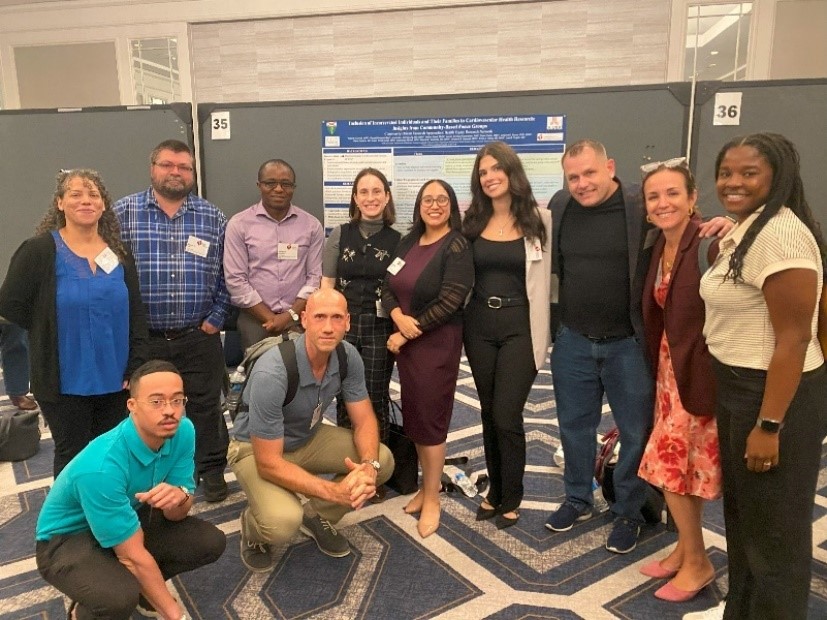
The Yale and JLUSA teams presented a poster entitled “Inclusion of Incarcerated Individuals and Their Families in Cardiovascular Health Research: Insights from Community-Based Focus Groups” at the CDRA HERN Conference in Dallas on September 8-9th. The poster detailed results gathered from Aim 1 of the study, highlighting insights into the research process, particularly in the areas of inclusion, ethical engagement, consent, biological data collection, and recruitment.
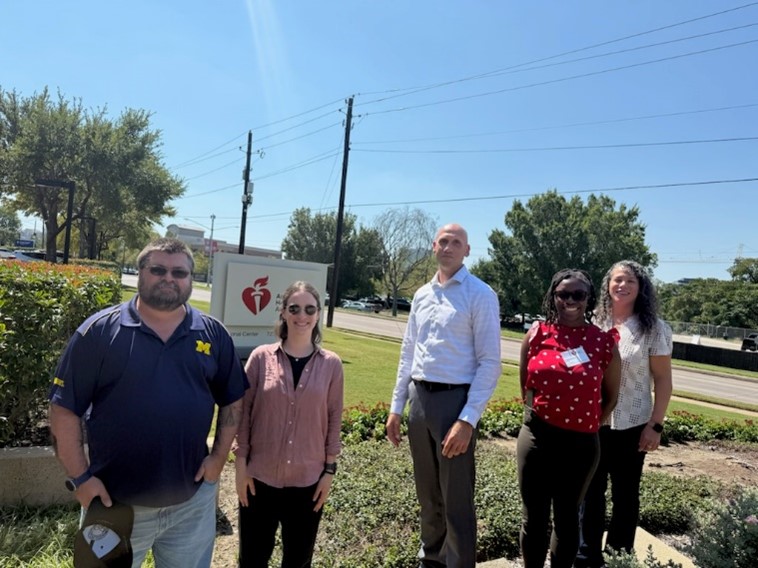
In addition, Emily Wang and Bill Basel presented hub updates to other Community-Driven Research Approaches HERN participants. Fellows Dr. Aaron Kinzel (JLUSA), Dr. Rachel Sweeney (Yale), and Cassandra Michel (Yale), along with Bill Basel and Dr. Johanna Elumn, also visited the AHA headquarters in Dallas during the conference on September 11th.

Training Updates
JLUSA and Yale are finalizing a three-phase, 18-month community-engaged research curriculum to be utilized with research fellows and potentially across the hub. The curriculum includes:
-
Foundations and Leadership Development
-
Community-Engaged Research: Design to Dissemination
-
Skills for Engagement and Self-Care
As part of community engagement efforts, JLUSA fellow Dr. Aaron Kinzel traveled to Washington, DC, to participate in advocacy training with EdTrust, which focuses on empowering justice-impacted communities. While in DC, he visited several sites and met with local advocates who help shape criminal justice reform and develop strategies to mobilize people for effective change. Dr. Kinzel also received a behind-the-scenes tour of the Library of Congress, where he viewed original artifacts such as drafts of the 13th Amendment to the United States Constitution. He obtained a Reader Identification Card, granting him access to the largest library collection in the world, which will support his contributions to the JUSTResearch project.

Yale and JLUSA Welcome New Team Members
-
Dr. Rachel Sweeney, a general internist admitted to the National Clinician Scholars Program in New Haven, joined as a fellow at the Yale SEICHE Center.
-
Cassandra Michel, a recent Master of Public Health graduate with a focus on social-structural factors driving health disparities, joined as a fellow at the Yale SEICHE Center.
-
Dr. Aaron Kinzel, a directly impacted criminal justice professor at the University of Michigan-Dearborn, joined as a fellow at JLUSA.
-
Lea Hunter, with a background in policy and monitoring and evaluation, joined JLUSA as a Research and Partnerships Coordinator.
CDRA HERN Conference and Focus Groups in San Antonio, Texas
The Yale and JLUSA teams attended the CDRA HERN In-Person Meeting on May 22, 2025, in San Antonio, Texas. During the meeting, the teams presented research updates to HERN and participated in discussions with partner institutions and community organizations. The convening strengthened collaboration between academic and community partners, facilitated the sharing of lessons learned, and aligned ongoing projects with broader HERN network priorities. HERN members also discussed training curricula.
While in San Antonio, the Yale and JLUSA teams conducted the third focus group with individuals who had been imprisoned (n=5) and their family members (n=6). Preliminary results from Aim 1 (qualitative focus groups) were later presented at the Dallas conference.

Focus Groups:
- The first focus group was held on December 12, 2024, in New Haven, Connecticut, with a total of 12 participants. This group included six individuals with prior incarceration experience and six individuals who were either family members or romantic partners of formerly incarcerated individuals. Qualitative data analysis is currently underway, which includes a follow-up expert convening to discuss key themes and findings emerging from the transcript.
- The second focus group was conducted on April 8, 2025, in Durham, North Carolina, and included 14 participants. A third session is scheduled for May 21, 2025, in San Antonio, Texas, with 10 participants recruited to date. As with the previous groups, participants include individuals with prior incarceration experience and their family members or romantic partners.
- These focus groups have yielded valuable insights to support the development of ethical and effective strategies for engaging formerly incarcerated individuals and their families in cardiovascular health research, especially in areas such as consent and data sharing. Findings from these sessions will inform the implementation of Aim 2 of the project, which centers on community-engaged research practices with this population.

Dr. Lauren Brinkley-Rubinstein
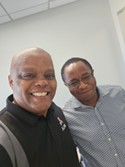
JustLeadershipUSA has entered into a consulting agreement with Dr. Lauren Brinkley-Rubinstein of Duke University, who is serving as a scientific advisor for the FAMJustice and INJustice projects. A national expert on the intersection of the criminal legal system and public health, Dr. Brinkley-Rubinstein played a central role in recruiting for and hosting the April focus group in Durham. She is also supporting JLUSA in developing a project advisory panel and assisting with the hiring of new project staff and fellows.
Focus Group Conduct
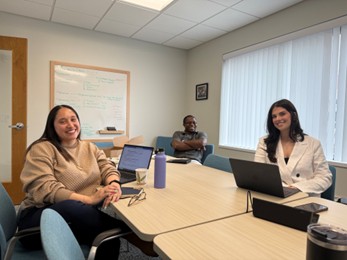
Yale has collaborated closely with JLUSA to ensure effective planning and implementation of the focus groups. Coordination included consistent communication via email and biweekly meetings. Yale developed a manual of procedures to guide recruitment, screening, focus group facilitation, and data analysis. Collaborative efforts led to the creation of a screening worksheet, customized recruitment flyer, adapted screener script, and debriefing questions for facilitators. Additionally, a community health worker from the Transitions Clinic Network assisted with recruitment efforts for the second focus group.

Regulatory
The project received Institutional Review Board (IRB) approval for the inclusion of additional JLUSA team members, as well as for the recruitment flyer and participant screener.
Training Program Updates
- In March 2025, the JLUSA-Yale training team convened a curriculum development discussion with current students and trainees at Yale, including individuals directly impacted by incarceration and JLUSA training program alumni. The session focused on refining draft content for a forthcoming training program tailored to incarcerated and formerly incarcerated populations. Key themes included participatory learning, trauma-informed approaches, relevance to lived experience, emotional support for researchers, and inclusive content development.
- The team continues preparations for the August launch of the JUSTResearch Multidisciplinary Training Program and is evaluating the potential integration of HERN training curricula. In collaboration with Furman University, the team provided guidance on trainee recruitment in South Carolina and discussed opportunities for cross-Hub training development. A joint curriculum meeting with all three Hubs is scheduled for April 24, 2025, with an in-person follow-up planned during the San Antonio gathering on May 22–23, 2025.