Amplifying Community Power in the Research to Identify Systems Changes Towards Health Equity
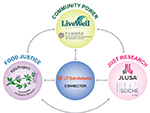
Amplifying Community Power in the Research to Identify Systems Changes Towards Health Equity – Furman University and LiveWell Greenville: This team will be led by Melissa Fair, Ph.D., community action director of the Institute for the Advancement of Community Health at Furman University and Sally Wills, M.P.H., the executive director of LiveWell Greenville (South Carolina). The team will study perception of community power among people from underrepresented communities, as well as how local government stakeholders view community input in their work. The team will form a community advisory board to create a model for training people to become more engaged in their community. They will study the effectiveness of community-based research projects in which individuals of lived experience have a more powerful voice, and specifically how that may improve chronic disease and health inequities. Additionally, the team will conduct an analysis of research studies that have included community participation in the decision-making process. The team will also explore how local policies have impacted chronic disease across counties in South Carolina and the deep South.
Aims List:
- Understanding Perceptions of Community Power in the Context of Local Government Decision Making
-
- Aim 1a: Understand how engaging people of lived experience in the research process shifts power and builds knowledge of the local government process to support grassroots advocacy.
-
- Aim 1b: Investigate how communities of color, directly impacted by power imbalances, perceive power and their ability to drive changes towards equal opportunities for good health in the landscape of local government.
-
- Aim 1c: Explore local government stakeholders and CBO stakeholders perceptions of their role in engaging people of lived experience in the local government decision-making and advocacy process.
-
- Aim 1d: Investigate local policy to better understand how policy and systems rooted in power imbalances are associated with differences in health status in South Carolina and surrounding states in the Deep South.
- Understanding and Building Capacity for More Effective Community Based Participatory Research and Partnerships
-
- Aim 2a: Form a community research advisory board using the Patient-Centered Outcomes Research Institute (PCOR) model to build a model for how to effectively train and engage voices of lived experience in the research process.
-
- Aim 2b: Conduct a mixed-methods nationwide study to better understand how CBPR is implemented and barriers to effective engagement of community partners.
-
- Aim 2c: Conduct a scoping review and meta-analysis of the efficacy of CBPR to improve chronic disease outcomes and unbalanced outcomes.